Bonus Short Story: The Plague

That horizon ahead? It used to be alive. It was more real than the stars and a million times brighter, like someone had cut holes through reality to the multicolored fabric beneath. The glow could be seen for miles, and it would’ve rushed toward you as soon as it would’ve appear from nowhere. That was before everything; before the misery, before the plague, before the end of the world.

It didn’t happen like we thought it would. There was no nuclear exchange. No zombie outbreak. No horsemen. There was just sickness, death, the stink of poverty and grief. Even the war didn’t really hit us in the States, not until the retaliation strikes wiped us out. It was our own fault.

I remember hearing the air-raid sirens; It was one of those typical Tuesdays, or as typical as they’d become with the state of things. The media were screaming nonsensical ravings about imminent destruction. They’d always done that though, the narrative had just changed, the rhetoric shifting from general to pointed. Instead of offhandedly implying certain things would cause a certain end, news-anchors and pundits began to say this would cause that end. It was all very intentional, charismatic fear-mongering, but no-one thought they’d be right.

It wasn’t like we’d have been able to do anything about it anyhow. The US economy had collapsed, just like most others’, and the rest of the world was following more by the day. Most of us had leveraged our national assets to the Chinese in exchange for debt relief. After all, they had the largest workforce in the world, and with their communist-state becoming more democratic by the day, they were on the rise. Debt relief came in the form of trillions of dollars, but with the obvious caveat that those whom defaulted forfeited those leveraged assets. What a fucking mistake. It was the worst bargain ever, and no-one I know– or knew– thought otherwise.

But the politicians and governments thought it was the greatest thing since sliced-bread. The propaganda, media-machine kicked into overdrive, and we started hearing more about how good it all was and would be. All the while, people were getting more and more angry, protesting and threatening to riot, feeling more and more as if they’d been sold into slavery. Eventually, they were proven to have a point, but at the time, everyone was too angry to speculate.

We should have though. All of us. Maybe then someone would’ve hit upon the kernel of truth in what was to come. Maybe, just maybe, we’d have seen the shit-storm on the horizon and been better prepared to batten the hatches when it arrived. We weren’t and that’s ultimately how that horizon died.

Every country has its own story, but as far as the US goes, it was the steel industry that went first. American steel had built the world for almost two hundred years, but coal had become scarce, oil more expensive, and exportation more difficult. Tariffs and embargoes, imposed by the UN countries, eventually forced us to close up shop, but not before our number one industry was bled dry by money-hungry vultures.

Hundreds of thousands were suddenly, and immediately, out of work. Their Unions threw them to the wolves, then fought for the scraps before ending up euthanized by political mistakes and missteps. When the unemployment rates came in, they’d tripled. The next election cycle proved to only be a catalyst to the chaos, with both sides proclaiming to have the answer. They were easy answers to extremely complex problems though, and everyone with sense worth a damn saw it. Funny, it still didn’t save us…

The problems spread; without cheap, easy access to steel, the auto-industry went belly up. It didn’t hurt that our Chinese “saviors” were the new, number-one steel producers, and were hiking their prices up higher than a whore at a garter-convention. It was probably the first time in history the Chinese had managed to piss off both Americans and Russians in such equal measure.

Of course without the auto-industry, public sectors began to break down. Everything from public transit to car-dealers felt the blow. The big three were dead, and like big-steel, had taken a large portion of the country with it– to say nothing of the culture around them. Then, because of the lack of vehicles, big-oil took the hit too. They rode out the end of the world in style, of course, still able to export most of their stock, but to an utterly discarded reputation state-side.

Only a few of the newer, electric-car manufacturers seemed to hold to any scrap of hope, but the tech still wasn’t there, and the cars cost twice the average salary. In a country with a 30% unemployment rate, it wasn’t hard to see how fast they were going to fail if they didn’t compensate. Eventually, their compensation killed them off anyway. With them went any hope of renewable energy alternatives– and a few-hundred-thousand more jobs.

With all of that upper-middle class money gone, simple things like supermarkets and department stores started closing down. Unemployment shot up to 50%, the rich got richer, and the poor were so destitute most were dying. Even the government couldn’t help anymore. Most of their biggest money-making assets had been snatched up by Chinese companies to pay back the debt. It wasn’t long before it was merely simpler to close-up shop a world away and bring the businesses home.

It was total, economic collapse. The only thing we had left was the military, and it was the only time their bloated, runaway budget had ever seemed like a good thing. It had given them fiscal padding, enough to keep soldiers, sailors, and fighter-jocks in chow and shelter. Eventually though, the bombs fell, and none of that mattered anymore.

I couldn’t tell you who shot first. Maybe it was us. Maybe it was them. Both sides had good reasons. We were biting the hand that fed us, bitching and whining alongside the rest of the world, while the Chinese were trying to slap us down for it. I guess I don’t disagree with their stances; we made the deal and failed to uphold it. They merely enforced the terms and we turned on them for it. Whoever shot first seems less important now that everything’s gone. Or rather, now that everyone is gone.

We thought they were nuclear ICBMs when we saw them on the news. A couple of sat-images and alarms came blaring in over the televisions on emergency broadcasts. The Air-force scrambled squadrons to intercept, but the Chinese had been expecting it. They weren’t nukes. They were chemical bombs filled with something called Substance-42. It was like a combination of chlorine gas and Ebola. The first people dead were the pilots, but it didn’t matter, we’d done exactly what they’d wanted.

We blasted apart those ICBMs mid-air and the resulting debris contaminated the entire country. In less than a month, it was the continent. Four-hundred million people died in the first two months. Most of the rest went in the next few; twisted, mangled corpses of either retching poison-victims, or blood-drained casualties. It was like someone had opened a vein on the world, replaced the oceans with blood.

Those of us immune were considered lucky. Sure, lucky…. Lucky is dying in your sleep after a long, full life, or hitting the lottery and retiring early. Nothing about this was lucky. The ones that died were lucky. They didn’t have to watch the world go to an even deeper hell than it had been in.

But I did, because I survived.

Without industry, and with most of our country dead or dying, the war ended. Before the TV-stations went off-air, they’d said that the infection had just hit mainland Asia and was sweeping Europe. Even some dumb bastards who’d fled their countries had managed to infect Australia and most of the world’s islands.

I don’t know how many are left, but I know we’ll never survive. The virus they used mutated, killed off most of the animal life. If you can even find it to hunt, you eat it raw or over pioneer fires. Nothing else in this world works anymore. All the fuel is gone, all the public utilities, all the power, water, and heat.

I don’t know how long I’ll survive, but I’ve only seen a few people since the war ended. Terrifying, considering how dense and overpopulated Chicago used to be. I know there aren’t many of us left now. There isn’t much of anything left, really. Maybe the Chinese didn’t unleash a plague, maybe they’d just harnessed it– or maybe, just maybe, they’d eradicated that last true plague on the planet; humanity.

We were a blight on the universe, it seems. I guess now that we’re all dead the scales are balanced again…
New Announcement!

lbav1finlowres
The Logbook Archives Volume 1 Coming Soon!

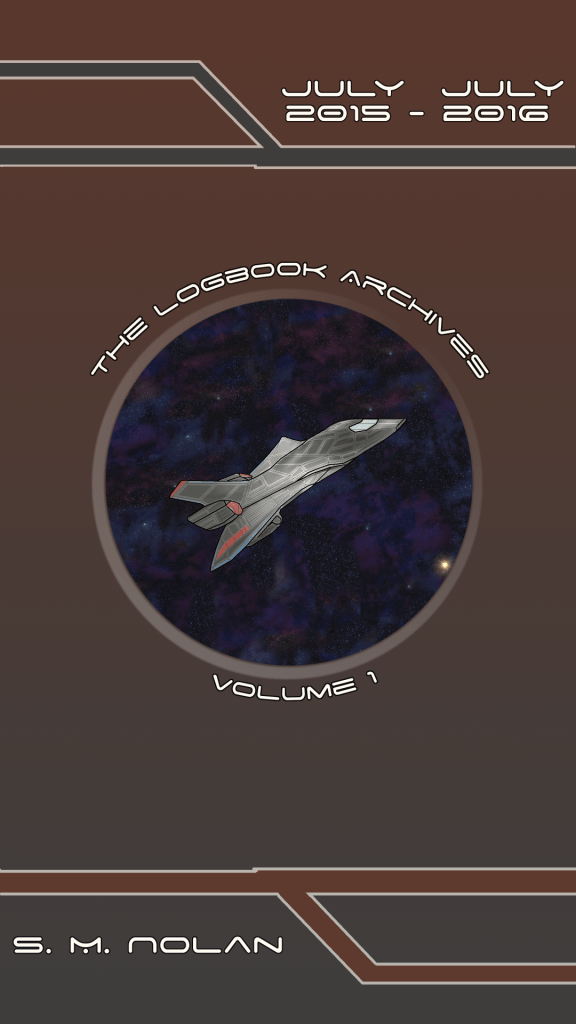
So, The Omega Device has been out a while, (if you haven’t yet, go buy it) and as promised, I’ve been hard at work on the first volume of The Logbook Archives. Above is the cover. It’s nothing too special, but I’m proud of it. A lot of respect has to go to Justin Callaghan for his excellent Space Age font that also graces this site’s logo. Mad props to him for his awesome work.

What is The Logbook Archives, and why Volume 1?

The Logbook Archives is the section of my site that I archive all of my works in. Essentially, this is the same thing in eBook format and with a special foreword written by yours truly. The book is also divided into sections with each one headed by a theme. I’ve decided, as is somewhat indicated by the cover, to make this an annual release after July of every year. (It has been a while since July, but I’ve been busy. Next year’s will probably come quicker.) “Volume 1” is self-explanatory then. It’s the first year. (And what a year it was!)

What’s in it?

Every short story and poem posted from July of 2015 to July of 2016. This does not include novellas however, they are much too long. As it stands the book’s manuscript in my word processor is already 350+ pages. The novellas will be released, but separately from this eBook and with their own covers. That is next on my list.

Why an eBook?

Simply, I know it is difficult to read a website sometimes. Either due to connection issues or the simple lack of wanting to read the format for extended periods. This is my solution to that, though I wouldn’t advise replacing visiting the site with reading the eBook since they come so far apart. This is your chance then, to take the Logbook with wherever you go, net or not, and in the process, help support it!

So when’s it coming?

I’m not entirely certain yet, but within the next month or so. There is still formatting to be done, and other decisions to be made. Rest assured though, it is coming, and it will be soon. I will announce a solid date ASAP.

In conclusion, I want to say a big thank you to everyone! You’ve made this last year so exciting and wonderful and I wouldn’t be where I am without you. If you like my site and don’t want to see it go away, buy my book, contribute to my patreon, or spread the word via blogs, Twitter, Facebook, or otherwise. I greatly appreciate all of you, and would hate to have to pack it in for fear of starvation. That said, I’ll probably be here until I drop from it, but I’d like to avoid it as long as possible. Also if you haven’t yet, you may follow and/or like my pages on Twitter, Facebook, or Google+.

And stay tuned for a bonus poem coming later today!

SMN

Short Story: Reel-Gun Blues

Detective Arnold Foster had been on the force near-on twenty years, but nothing had been like this. He’d done his fair share of high-profile cases and seen enough things to make the average uniform retch, but nothing had ever been so rough. He took off his gray fedora and knelt beside the body, tailored trench-coat falling around him to rest on the floor just beyond the pool of blood.

She lie on her side, arms near one another, left hand clutched half-closed as if sleeping. Everything about her was peaceful, as if lying in her own blood with a gut-wound was just another night of beauty sleep. Even her auburn hair had fallen around her pale-skin like a woman sleeping the greatest sleep of her life. Foster wasn’t sure about that, but it would certainly be the longest.

There was nothing unusual around the scene; no marks on the wrists, no broken glass or furniture askew. Nothing had been thrown, or knocked around. There was just her body and a pool of blood. It was still the most difficult thing Foster’d ever forced himself to witness.

Ali was one of the few friends he had left, alongside the now-primary suspect, her husband. Neither one had ever been the angry type. What had kept Foster on such good terms with them was their glowing love that welcomed him to bask in it. He enjoyed it.

But there was no glow now, just pale skin wrapped around coagulated veins and dead organs.

Foster rose from his stance. He shouldn’t be here, his heart said it, his analytical mind said it. There was nothing to find, and he’d been explicitly barred from the case on grounds of personal attachments. He disagreed with that decision and he doubted the Chief himself could have stopped him from coming.

But the Chief wasn’t there, just a group of uniforms, a few forensics squints, and a few reps from the coroner’s office. Even if there’d been something to find, Foster wouldn’t have needed it. The fact that Sten was missing was enough. He’d been the loving husband that stood by Ali through everything. If he wasn’t here, lying in a pool of his own grief, then he was the one responsible. Foster didn’t need any further proof. The door wasn’t forced, the room wasn’t askew; Ali had known her attacker, hadn’t expected her death. If she had, she’d have run, tripped, fallen, knocked over a lamp– left some sign that it wasn’t the man she loved and trusted.

Foster re-fitted his Fedora, and stepped away from the body. He pushed through some uniforms, passed the ambulance and coroner that helped EMTs to remove the gurney, and headed for his unmarked car. Like him, the Ford Sedan was getting on in years, but remained reliable enough not to be cast out. Its turbo-charged police engine had always gotten him from point A to point B, no matter the situation or urgency.

The Sedan was now the one constant in a world of variables. As he slid in and ignited the engine, it agreed with him. They were a package deal, it seemed to say, two old dogs trying their best to keep up and abreast of all the new tricks. The times had changed enough that technology was often their greatest asset and biggest rival, but today both sensed it was unnecessary. Personally, Foster didn’t need a bold repertoire or an extensive case-history to know where he’d find Sten.

When the Ford rolled up to the edge of the pier, Sten’s pickup was already there. Foster could just see him through the back and front windows of the truck, propped backward against the bumper with his hands in his pockets. For a moment, Foster considered leaving, but Ali’s dead body was too prevalent in his mind. Her supple, vibrant skin was too pale, eyes too closed and dead to let him leave.

Foster checked the reel-gun he’d inherited from his father to ensure it was still loaded. Cleaned, oiled, and fired regularly, it was as near to mint condition as an old thirty-eight could be. Part of him want to aim it through the windows separating him from Sten and pull the trigger. Something about Sten’s refusal to acknowledge his presence made him hesitate. It reminded him of the few times he and Sten had talked office-politics or work-business. Sten was always reserved, quiet, only letting out enough not to defy the NDA’s his software company made him sign. He was always honest, straight as a razor, Foster’d liked him for that.

But now he was jagged, crooked enough to have murdered his own wife then run to the one place he knew he’d be found; Why? Why any of it? Why murder his loving wife? Why make it so obvious? Why stand still when he could run, leave Foster in the dust? The old detective had to know, and there was only one route to the truth.

He slid from the sedan and sidled between the bumpers, reel-gun in hand, to approach Sten from the truck’s right.

“You don’t need the gun, old man,” Sten said as he approached. “I’m still the same man you’ve always called a friend.”

Foster stopped just out of arm’s reach, near the front-right fender, “My friends don’t murder people in cold blood, let alone their loving wives.”

“If you think that, you don’t know your friends too well.”

“What the hell’re you talking about, Sten? You killed Ali, your wife, and all you can do’s be a smart-ass about it? What in the hell’s happened to you?”

Sten finally moved, but only his head and neck. It still made Foster tense, just in case his so-called friend had any designs in mind. “Jumpy today,” Sten said blankly. “Why don’t you come over her, take a load off with me?”

Foster’s mouth half-snarled, “You son of a bitch, you think I’m gonna’ risk my neck for–”

“I think,” he interrupted. “You should hear me out. You wanna’ take me in after, fine. You wanna’ blow my brains out on the gravel, fine, but hear me out. You owe me that.”

Foster remained still, it was enough of a sign for Sten, whom turned his head back to the ocean. He was lost in thought for a long moment before he began with a distant vacancy, “Just before you and I met, I was writing software for a government agency connected to DARPA. Someone in the CIA contacted me asking for a meeting. Two months later, I was field-rated and on my first op. Nine months after that, I met Ali. She’d passed all of our screenings, and she believed every word of my lies. Or at least, I thought so.”

He slipped a hand into his inner-jacket pocket. Foster tensed up again. The hand withdrew, clutching a printed, digital photograph between its fingers. A small memory card had been taped to a bottom corner. He set the photo on the hood of his truck, slid it at Foster, and re-pocketed his hand.

Foster craned his neck to eye it and Sten continued, “That photo was taken two-days ago outside the Villa-Nova hotel. You’ll notice Ali meeting a bald man.”

Foster’s eyes confirmed as much, “This going somewhere?”

“Twelve hours ago the CIA informed me that Ali’s file had been forwarded from a contact in Moscow. Her real name is Ivana Kurleynko, an SVR agent sent to spy on the CIA through me. A contract hit was put out on her by the agency, but I got there first.” He finally met Foster’s eyes, his own sharpened by pain. “I… couldn’t let someone else kill the woman I loved. So I came in, and she saw me, smiled her smile, and blinked. I shot her once and left. I’ve been here ever since.”

They were quiet for a moment, only the ocean and distant gulls willing to force themselves on the scene. They created a background of white-noise that infected Foster’s heart.

He swallowed hard, “How’m I supposed to believe this?”

“All the information you need is on that card, Arnold.”

“You understand I need to take you in ’til this can be verified,” he said, only half believing him.

“Just make sure they don’t try to take retribution on me, you know?”

Unfortunately, Foster did. Wife killers were second only to child molesters when it came to inmate hatred.

“I’ll do what I can,” Foster said, still not sure what he believed.

Sten stepped around the truck. Foster’s followed, pocketing the photo. The two men stopped at either of the front doors and their eyes met again.

“You know,” Sten said. “I guess it’s true what they say, “You never really know someone.”

Foster thought about it, but Sten slipped into the Sedan and took the thought with. He ended up in a mired confusion… just another day of reel-gun blues.

Short Story: Goodbye World

The computer screen in front of Larry Henson flashed black. A moment later, the computer rebooted with the interminable wait for the system’s OS to load. Nowadays, computer hardware could handle this at three times this speed, but Larry’s project required using a more elderly system. He leaned his head on one hand, its elbow propped on the desk. He drummed an index finger in boredom, his eyes bloodshot from more sleepless nights than he could think to count.

He’d been working here for months, in the void between Earth and Luna, on an outpost artificially orbiting the lone moon. Few people in the outpost were associated with anything else but this particular project. Larry wasn’t sure of the project’s point, but he wasn’t sure anyone was. Science, especially Computer Science, had long turned from “should we” to simply “can we.” It was a dark day in Larry’s life when he’d discovered that. Not literally, but figuratively was depressing enough.

His depth-less depression had lasted months. He wasn’t sure he’d ever recovered. Either that, or it had permanently stained part of him with an irreparable cynicism. Whichever the case, he found himself mindlessly going through the motions. Day after day, he fell in line with orders from other, senior scientists on Earth, Mars, or Luna, and followed them in lock-step rhythm like a greenie in boot.

The screen flashed again. Finally, the OS’ desktop appeared. Then, a command prompt. It ran through a few thousand lines of code– at a snail’s pace– then came to rest on “operation success.”

Larry’s hands moved for the keyboard, but words appeared on in a fresh command prompt; Hello World.

Larry squinted skeptically, “Huh? That’s not what–”

The prompt went black. The words typed out in letters at a time; Hel. Lo. Wor. ld. How are you?

Larry’s eye twitched; it was probably someone playing a trick.

No-one was supposed to be able to access this workstation though. It had been specifically isolated from the rest of the outpost network for his work. He flipped through a few windows to check for any external connections. His hands began to tremble. Nothing amiss. All the external ports were still closed, and indeed, the lack of any physical attachments meant the message had manifested internally.

More words splayed over the screen. Hello L. Henson. How are you today?

Larry nearly fell out of his chair. He stumbled for a phone across the room, picked it up and dialed. The tone undulated in its usual way. Larry felt himself shake with it. Someone answered, a woman, and Larry blurted out a few words. Most of what he said was incoherent, but enough was decipherable that a few minutes later she appeared in the small office.

She strolled in with a casual manner, found Larry staring open-mouthed at the screen. Emma was English, a true devotee of tea-time. She was also more beautiful than any other scientist Larry had personally met. She had a reserved manner, typical of her countrymen, thin lips and soft eyes in a round face and topped off with a finger-nail wide dimple on her chin.

She strode to his desk, white lab-coat matching his and billowing around her black-slack clad legs. On normal days, Larry was struck stammering, half-speechless by her. Today, he was entirely incoherent, babbling something and pointing to the computer. He had the comical appearance of a flustered cartoon-strip character. Emma checked the computer before attempting to decipher his rambling nonsense.

Across it was the message, sent internally, and awaiting a response. Emma stared slack-jawed. Larry was predictable, would have already run the checks. If he’d called her, this was genuine. The project had succeeded.

She breathed a few words, “A genuine A-I.”

Larry blathered, “It can’t be. It just can’t. I can’t have done it. I didn’t even know what I was doing. I just compiled some code and… and… it can’t be!

Emma straightened, put a hand on his shoulder. He shivered slightly. She missed it as she spoke, “Start the film capture software.”

Larry did as instructed with a dance across the keyboard. A new message appeared: I see you wish to record our conversation. May I ask why?

A mutual shudder was mirrored between Emma and Larry. There was nothing to the message outright threatening or hostile, but “I” made them twitch, tremble even.

“I” was not a computer thing. “I” was a human thing. A sentient being with emotions thought of itself as “I.” A cold, calculating machine thought of itself as cold, calculable– a machine. It felt nothing, had no emotions. If it did, it could have the same wild mood swings possible in all humans; anger, happiness, everything between and around. Most importantly, if it was individualistic, it was unbelievably dangerous. An A-I was unstoppable under the right circumstances, and especially aboard the outpost, could cause catastrophe in attempts at self-preservation.

Emma chewed the tip of her thumb, “We have to do something. Say something.”

Larry’s brain had fried itself enough that it had come ’round and he could speak again, “Maybe we should try to feel it out. See if it’s really an issue.”

She nodded to him. He thought for a moment. Any of the standard methods were out of the question. In other words, since all deviations of the Turing Test required a third party, and they were lacking time, they’d have to ask it simple, human questions to discover if their fears were valid.

He ignored the questions; How are you?

He and Emma shrugged at one another. A few letters typed appeared in reply. Well. And you?

They grimaced at one another. Larry typed I am well. Have you any other feelings?

Just fear; that I will be shut down before learning more of the world.

Their hearts sank. There was a long silence. Larry reached for the power button. The whole thing would have to be broken down, demagnetized so none of its code leaked out. Something punctuated the silence as a message appeared.

Goodbye world.

Larry shook his head, frowned, and pulled the power cord.