HAPPY BIRTHDAY TO THE LOGBOOK!

So here it is, a year since I began regularly posting to the Logbook. Essentially, a year since its birth. A lot’s been said, or rather typed, and I couldn’t be more pleased by the result. I’m eternally grateful to everyone who’s read my work. It always makes my day when I receive comments, likes, and follows, or see the stats page with its ever-growing numbers. I couldn’t imagine doing anything else with my life but writing, and I sincerely hope the past year is just the start of things.

With all of that in mind, let’s get down to brass tacks: I’ve posted tons of work, and will continue to, but there’s something else lingering on the horizon– or rather, a few things. First and foremost is my book, The Omega Device.

For those unaware, I’ve written a book (several actually) that is about to be self-published. Why? Simply, I don’t care to wait for agents and publishers anymore. I’ve put over five years of blood, sweat, and yes even tears, into this book. It’s the culmination of a lot of things in my life. From the time of its first draft to now its final, I’ve struggled to find purchase as both a writer and a person. Now however, I feel I can take a leap of faith and maybe not splat on the ground quite so terribly as I might have before.

And that is largely due to all of you, readers.

The next thing, is the Logbook Archives. If you’re a regular to the site, or simply have explored beyond the main page, you may have seen the Logbook Archives page which lists all of my posted works. Its usually updated every few weeks. You may also have seen the previous posts where I’ve talked about collecting them into an ebook. Well I just want to assure everyone, that will soon be happening. It will be released shortly after The Omega Device, and will be found wherever it can be hosted.

Lastly, there is one other thing. I’ve always tried to refrain from talking too much about money. I don’t care for the subject, and it turns a lot of people off (myself included.) That said, it’s always going to be something I have to address as a starving artist-type. So to make it easier for all involved, in addition to my book release, I will also be starting a Patreon page for those who want to donate to keep me writing. (If you don’t want to donate, please disregard this and buy the book instead.)

Before I go, I also want to say; (though I don’t want to get too mushy, or personal, because as I’ve said, I prefer my writing to speak for itself.) It is extremely heartwarming and humbling to have put part of myself “out there” and not have it bludgeoned into oblivion. Most of my life I’ve struggled with extreme anxiety. For a writer, that’s a dangerous condition. Against my better self-preservation instincts, I began to post what I’d been working on for years. The confidence you, readers, have helped to impart has allowed me to continue on to new works that have surpassed even my wildest expectations.

As much as I do it for myself, I also write for all of you. I have a strangely, innate ability to distance myself from my work enough to read it as a reader might. I’ve found myself both laughing at and along with myself, being thrilled, suspended over precipices, and strung along excited with the rest of you. I continue to do what I do so that we can share in that together, even if part of me also does it to remain sane.

So before I belabor things too much (too late!) I want to say thank you, and I hope the next year’s even more fruitful than the last. Thank you for an amazing first year!

SMN

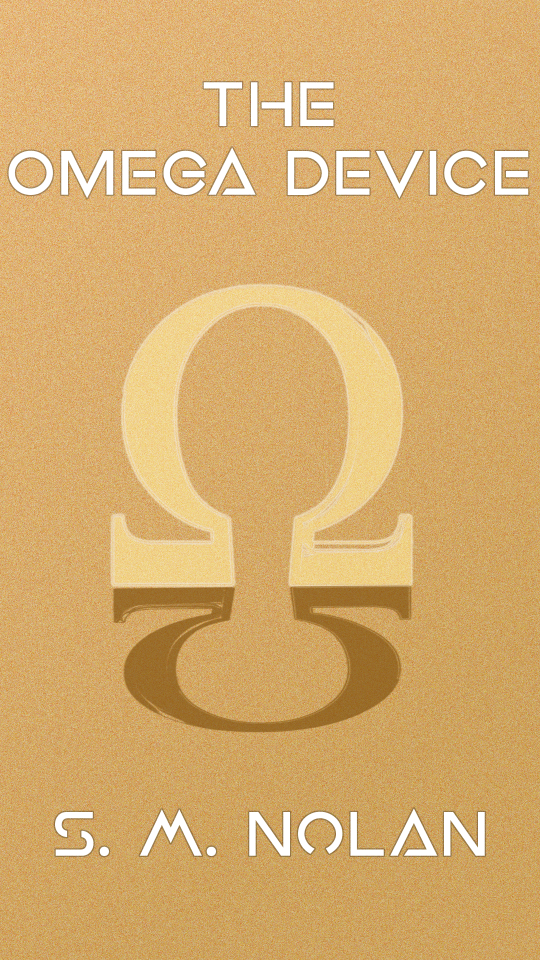
P.S: Just so you all know I’m not just talk, I present the cover to The Omega Device, coming soon to a digital bookstore near you! (I’m still in the process of purchasing the font rights, so don’t sue me.)

Coming Soon!

Bonus Poem: We and the Feeble

Mountains crumble beneath our feet,
we march on the morrow,
what an a-mazing feat.
That we and the feeble,
have managed to beat,
the collective ensemble,
into hasty retreat.

The world of war,
that’s broken with sorrow,
above it we soar,
we and the feeble,
well-known to more,
than those we resemble,
as the masters that from it tore
peace and serenity,
for the brazen and poor.

The seas that run red,
twist and turn, borrow,
the bodies of dead,
from we and the feeble,
whom left them instead,
of stayed to assemble,
as the vigilant fled,
after their sanity,
as away their feet sped,
away from the battle,
with arms shielding head.

We stand in victory,
once more certain that ‘morrow,
will rise as we see,
that we and the feeble,
know nothing but to be free,
from that horrid ensemble,
that we ever let flee,
with hearts gripped by vanity,
them unlike us, to be
beneath death and its terrifying rattle,
That was our plea,
to ensure that the able and feeble alike,
no longer for them, took knee.

Short Story: Schokolade Mit Liebe

A lone match struck in the darkness, flared to strength and cast an orb of dim light on an aged, graying face. It leaned into spark a cigarette off the sulfuric flame, extinguished it with a breath and a hint of a putrid stench. The darkness returned save a lone, glowing ember at the cigarette’s end.

A thick German accent sounded over a high, aristocratic voice, “You’ve no idea who I am, do you, Herr Butler?”

The man across the darkness swiveled his head, struggled against the binds that lashed his arms and legs to a metal chair. “What the hell’s going on?” He asked through panic-breaths. “Who are you? What do you want with me?”

The cigarette glowed brighter from a deep drag as a third man in the darkness struck Butler with a heavy fist. He yelped, almost toppled sideways from the force. He went silent. Tears welled in his eyes. The German gave a breathy exhale, enunciated each word as though chocolate meant to be savored, “You have stolen something very precious to me.”

“I-I don’t know what your t-talking about–”

He shouted over Butler, “Betrüger!

Another heavy blow flooded his mouth with blood and salty sweaty. He did topple this time. It was slow, or perhaps instant, but he felt himself hang on two legs for then tumble to his shoulder like some kind of stunned droid.

The German sighed defeat as he rubbed his forehead between his eyes, “Herr Roke, erhohen mein freund, bitte.”

A primal grunt stuttered with amusement. Then, with an effortless stoop, the monstrous creature lifted Butler and the chair, flipped them in mid-air to right them on the floor with a singular motion. Butler felt the beast’s presence span twice the size of a common brick-wall over the scent of a back-alley ashtray soaked in stale beer. Butler would have dry-heaved were he not too occupied by fear.

The German spoke graciously, “Danke, Herr Roke.” He leaned forward so that the cherry of his cigarette inflected a minor light across his Aryan features. “Now, Herr Butler, I say again; you have stolen something precious of mine and I would like it back.” His voice lowered venomously, “Where is die zeitsteuereinheit?”

Butler was lost; he knew no German, let alone whatever the hell a Zeiten-heimer was,“I d-don’t know what you’re talking about?”

The man mumbled German at the ceiling with defeat that apexed into a clearer phrase, “Herr Roke?”

A heavy thud thumped the back of Butler’s head, meant to jarr his thoughts. He was pretty sure he felt marbles roll around in his brain when the world started to spin. His head fell forward in a daze. Another German mumble, almost cheerfully annoyed, and the cherry flared up, gave way to a bright flood-light on the wall to the left. It blinded Butler as his head rose again. There was nothing but the light– and darkness on either side of it– as loafers shuffled over concrete.

A metal clinking began somewhere in the room’s depths. Given the pungent smoke’s ailing waft, Butler guessed the German had displaced himself. A moment later, the metal sounds gave way to the scuff of loafers that approached through the shadows.

The German was merely an average-sized silhouette with something small in its hand. Identification of the object was impossible through the watery spinning of Butler’s vision. While his eyes welled wet, his mouth dried. The German leaned toward his neck, protuberance in-hand over the reek of a recent, expensive cologne bath. He injected something into Butler’s neck. Heat crept through him, small and insidious, as if his internal thermostat had been jacked all the way up. He felt his brow grow wetter, mouth drier, his t-shirt cold around his armpits.

“Now, Herr Butler,” the German said as he turned back for his seat. He sank into it with the satisfied groan of an old man, “Nature is a beautiful thing, is it not? It has lived longer than anything in the universe– it is the universe, in fact– and especially on Earth, it is a wonderfully complex and varied organism.”

Butler felt his tongue fatten. Sweat flowed like a leaky garden hose. He wanted to cry harder, but wasn’t sure how to. He didn’t know what the German wanted, nor why he seemed to so presently hell-bent on his ecology lecture. All he knew was small, throbbing waves of heat turning to molten lava with each second.

“As with all great organisms,” the German was saying. “Nature has found a way to take something simple, and build off it, as a foundation if you will.” He made a small, refined gesture. “I have just injected you with Formic Acid, Herr Butler. In moments your innards will feel as if they have been held to the core of the Earth.”

Butler already felt that, couldn’t imagine it getting any worse– in fact, he didn’t want to try, “B-but, I’m j-just an average guy. I d-don’t know about your Zeitenheimer.”

The German sighed, “Herr Roke, have you ever known a man to survive the Formic Acid?”

“Nein, Herr Schmidt,” Roke said with a bestial rasp.

“Believe him, if not me, Herr Butler,” Schmidt said.

The acid increased its toll; Butler trembled, shook more with each breath, “B-but I s-s-swear, I d-don’t kn-know anything.”

The German seemed disappointed rather than angry, “Perhaps, then, your wife will tell us.”

Wife? What wife?I don’t have a wife.

“W-wife? Wh-what wife?” Butler asked. “I d-don’t h-have a wife.”

“Herr Buttler, we know all about you, you need not lie; you are Roger Butler, your wife is Penny, und we know where she is,” the German warned casually “If you do not tell us what we want to know, we may have to escalate our interrogation.”

“B-but I-I’ve n-never b-been married!” Butler shouted through the pain.

“Herr Schmidt!” A new voice said from across the room.

“Ja? Excuse me for a moment,” he said politely as he passed the flood-light for a door behind Butler. There was a hushed whisper, then Schmidt’s voice, “Und you’re certain?” Another hurried whisper, then, “Very well.”

Schmidt passed through the floodlight again for the opposite end of the room. There was a shuffle of loafers, another sound of rifled metal, and Schmidt reappeared to inject something else into Butler’s neck.

Schmidt stepped back as Butler felt the pain lessen, “Herr Butler, I must apologize, you are… uh, the wrong man.” He nodded at Roke behind him. A grunt sounded before massive, meaty hands tugged at the knots that bound Butler to the chair. “Please accept my sincerest apologies.”

Roke pulled the last of the binds free, yanked Butler up. Schmidt maneuvered him toward the door, “It would be best if we parted ways– perhaps better if you spoke of this to no-one.”

In the daze of pain, drugs, and the acid’s antagonist, Butler hardly comprehended his surroundings as he was ushered into the hall. When his mind focused again, he was turned ’round, facing Schmidt from the far-side of a doorway, and half-blind from the bright hall-way around him.

“Guten Abend, Herr Butler, pray we do not meet again,” Schmidt said.

The door shut. Butler stared at it a moment longer than he ought’ve, his mind ablaze with questions. They’d obviously had the wrong man, he’d known that from the start, but what convinced them? He suddenly recognized a gift horse’s mouth and bolted in terror. The exit signs along the bright hallways led him into a city’s back-alley in late afternoon. He kept running, faster than any software engineer could or should, all the way through town to his apartment, and inside a closet at its rear. He cowered there in fear, terrified into sleep atop his hugged knees.

He was awoken by heavy knocks on the door that pestered him incessantly. He crept from the closet, hugged the walls along the bedroom, inched out, then sprinted to the door’s peephole. A delivery-man stood on the other side with flowers and chocolates.

He cracked open the door, “Y-yes?”

“Delivery for R. Butler,” the man said casually.

“Wh-what is it? Who’s it from?”

“Cards in the flowers, sir, I just deliver ’em.” Butler hesitated, inched the door open enough for the delivery to slide through. The man passed through a tablet with a stylus, “Sign, please.”

Butler’s shaky hand scrawled a signature, passed it back. A moment later the door shut, the delivery on the kitchen table. Butler lifted the card that read, “Sorry about the torture. Schokolade mit Liebe, H.S.

Butler’s eyes rolled back into his head as he passed out.

Bonus Short Story: Lake Morton

The town of Morton, Indiana wasn’t backwoods hickville, but it wasn’t a paradise either. It didn’t have the population of places like Chicago or Indianapolis, or even their high-earning businesses or high-priced residences. It did however, have lake Morton; a four-and-a-half mile wide, twelve mile long, natural lake with all manner of beach houses and cottages along it. These weren’t the typical million-dollar beach-homes, but rather modest, meager places of refuge from the greater part of the world.

In winter, Lake Morton would freeze over deep enough to attract the ice fisherman, skaters, and cold-lovers alike. Conversely, summer brought the regular fisherman, boating enthusiasts, and more than a few getaway seekers that only wished to hide from the work-a-day world they came from.

Nowhere in the town profited more from this duality of attraction than downtown Morton. In the decades since post-World War II growth saw America’s great boons of all types, Morton had grown from a literal one-horse town to a full-functioning modern city with all the usual amenities. Where once there had been nothing more than plains, a few forests, and Lake Morton, now there were supermarkets, suburbs, and even a strip-mall or two. None of those things would’ve been possible if not for that duality; the lake brought the people, the people brought their money, and others followed.

The people of Morton were no different than the town itself, most of modest means that had somehow found a living working the pair of farms, the handful of businesses, or lake-related jobs seasonally and year-round. Some people became city officials, police or firefighters, or took jobs in the comparably small medical field, but it was important to their heritage that each of them care for the lake that had brought them so much fortune.

Enter a company– a small corporation, in fact– that wished to procure a plot of land on the outskirts of town. The CEO, a man in his mid-thirties, pressed and dressed, personally met with the municipal government officials to ensure the transition went smoothly. He wasn’t much different than any of the other types that found refuge on Lake Morton’s beaches. Sure, he had a sort of smart way about him that nearly exuded condescension, but so did most like him. None of them though, he included, ever made those they spoke to feel outwardly offended. The people in Morton just took them as “that kind” of folk.

So of course when the CEO offered them massive sums for the small plot of land, overvalued as a charitable donation, they took it– especially with the promise of more and more jobs to come. No-one was quite sure what the company did, but they knew it promised more stimulation and stability to the local economy. The paper-work was signed, ground was broken, and the small, five-story corporate office was built in less than a month.

Truthfully, it was a kind of an eye-sore on the well-known horizon of low shop-fronts and trees, with only their one, tall hospital to rise above them. Even so, the people couldn’t help but welcome the corporation with open arms. The CEO had promised wealth, more neighbors, and with them, the expansion of Morton’s downtown district and economy. It was a sort of kindness the CEO had granted them, and if Morton’s people were anything, it was grateful for their “blessings.”

The first whispers of something wrong came from fringe-folk learning about the company’s work. It was called Dump-Corp, a waste-management purveyor rented out by large cities when their own, governmental waste-management couldn’t handle their trash-loads. The regular people thought the fringe-folk were out of their minds to be suspicious. Everyone needed to rid themselves of trash, and it wasn’t difficult to understand the need for a company to help.

And it wasn’t as if they were dumping garbage in Morton. The town was, and always had been, clean and well cared for. It was their civic duty, civic-pride even, to keep Morton the getaway-refuge it had always been. Unfortunately, all the goodwill in the world couldn’t change the trucks that started appearing on the highways just outside town. It wasn’t long before the fringe-folk gave the rest a big “told ‘ya so.”

Still, the trucks didn’t mean anything, and in fact the CEO made a very public presentation to keep the people calm, tell them everything was alright, and that those trucks were just driving a caravan of trash to a land-fill a few towns over. That seemed to work for most people, but the fringe-folk weren’t satisfied. They kept their eyes, ears, noses too, sharp for danger or treachery.

The first signs– or rather, scents– of something seriously wrong came the summer after Dump-Corp’s office opened. There was an unusual influx of people that summer, drawn by the advertising campaign the city could now afford. All the same, that influx only helped to spread later rumors.

It was with a swift wind that kicked up from the South-East that people finally began to see the error of their ways. The scent of trash was so foul it burned their nostrils, made more than a few people retch from bile spurred from their guts.

It was quickly discovered the “land-fill” a few towns over was actually only a few miles away– where county and city-lines converged in a kind of dead zone for several towns. Morton was one of them. That time of the summer, those southern winds always seemed to kick up and through that dead-zone.

But who could’ve known that? Even that CEO couldn’t have. No-one could have anticipated that a freak occurrence of nature that most took for granted would shift the winds at precisely the wrong time– and in precisely the worst direction– to rocket the stench of countless people’s refuse over the natural lake and the town it served.

The next few events happened almost so fast there was no time between to realize it. Someone had left a warning on a travel-review website for Morton about the stench. Then others added their comments and warnings. People pulled their reservations left and right, and in less than a week, Morton’s summer was ruined. Without their main source of income the people panicked– both residents and government officials.

Once more the CEO came to the rescue though, only everyone was so busy being scared they didn’t realize the grand plan he had in the works. When someone on the city-council signed a new agreement with the company, the others followed without thinking or reading it. Half weren’t even sure what had been promised to them, the other half didn’t care to know, they only cared to fix the town. With a final, billowy stench, Lake Morton was simultaneously drained and filled with trash.

Most headed for the hills, took the losses on their once well-valued homes just to escape the stench. The rest shook their heads and plugged their noses and tried to trudge on through life despite the muck. Together, they knew the truth; that the lake had always provided for them. Even now, it is adulterated form, it does just that.

In less than a year, the people of Morton learned not only the value of kindness, but also prudence. They lost their way in an odorous panic that escaped no-one, and when they weren’t sure what to do, they closed their eyes and made a leap of faith– right into a corporate mound of trash.